On September 11, 2023 we began bargaining sessions with UMN for our first contract, which was ratified by GLU membership on December 6, 2024 and the contract was ratified by the UMN Board of Regents on January 21, 2025. This contract is now in effect for all graduate assistants.
Bargaining over which fellows meet the definition of a public employee and to establish a contract for fellows began on March 20, 2025.
This page has summaries of each bargaining session along with major events or actions, all of which you can view by clicking on the date below. You can also view the bargaining tracker sheet by clicking the button below, which contains detailed information on the current status and language of the contract proposals.
All proposals and articles were based on the platforms ratified by our membership on Workplace Safety and Quality of Life and on Pay, Fees, and Benefits.
Spring 2025
➤ March 20-21, 2025: First Fellows Bargaining Session
Session Scheduled. Stay tuned for updates!
➤ January 21, 2025: Contract Ratified by Board of Regents!
Contract Ratification: Grad workers at the U are starting off the semester with a brand new contract! Today, the Board of Regents met to ratify the GLU-UE 1105 Collective Bargaining Agreement. Raises from the contract have already been in effect, so graduate workers should see their first paycheck in February reflect the pay raise for the entire pay period.
Grievance Procedure and Stewards: With the agreement ratified as of 3pm on Jan. 21, 2025, the terms of our contract regarding things like health and safety, workload, and discrimination are in effect. GAs will now be able to use the grievance procedure if they feel that those terms are being violated in their workplace. Stewards are graduate workers who will help their fellow GAs determine whether and how to file a grievance, and help support them throughout the process of that grievance. You should contact a steward if you have a potential grievance. The steward does not need to be from your own department or college. If you are interested in helping to make sure the terms of our contract are upheld and assisting coworkers who are being treated unfairly, please fill out this interest form and sign up for an upcoming steward training!
Constitution Voting and Executive Board: Currently, elected representatives from each campus are working on creating a draft of our Union’s constitution which will establish the structure of our organization, for all members to give feedback and vote on. Feedback sessions will be held:
West Bank: 1/27 @ 1PM
East Bank: 1/28 @ 4PM
Saint Paul: 1/29 @ 4PM
Virtually: 1/31 @ 2PM
Keep an eye out for a follow up email with town hall locations. Once the constitution is ratified, members will elect an executive board to be the new leadership of GLU-UE 1105 going forward. More information about the constitution vote and the executive board election will be coming soon!
Sign up for Membership: Union members will receive member-only communication with additional information soon. Union dues will kick in for those who selected post-ratification on the membership sign up card. Dues are 1.44% of your monthly pay and are required as a part of union membership in good standing, to ratify our constitution, to vote and run for union office, and to participate in membership meetings.
It’s an exciting time for graduate workers! We have the opportunity to use this contract as a tool to create better working conditions for all of us, and we all can be part of that change!
Fall 2024
➤ December 6, 2024: GLU-UE Members Vote to Accept Contract
With over 2000 ballots cast and 84.6% voting yes, we, the members of GLU-UE Local 1105, have ratified our first contract!
We have worked expeditiously to ratify this contract and we expect the University to do the same. The Board of Regents, the body on the University’s side that will ratify the contract, has a meeting next week (Dec 12 & 13). We expect to see the ratification of the contract on the December agenda or in an imminent special session, however the University has not yet committed to an exact timeline. Send an email to the Regents and Board staff and urge them to move as quickly as possible, so that the contract can take full effect before the beginning of next semester.
Once this contract is ratified, the language will go into full effect and every grad worker should expect a pay raise in the first pay period after ratification. We will also need to continue building our member-run union by beginning the bargaining process for graduate fellows, setting up infrastructure for enforcing our new contract, drafting and ratifying a local constitution, and electing union leadership.
Our work is not done – please stay tuned for more information in the weeks ahead!
➤ November 27, 2024: Contract Vote Details and Materials
On Saturday, November 23nd, the Bargaining Committee tentatively agreed on a contract offer. Now, members need to vote on whether they will accept this contract. The vote will take place online, and will be open from Monday, December 2nd through Friday, December 6th.
The two possible outcomes of this vote are:
- If members vote YES: The contract will go to the Board of Regents for ratification, and could go into effect as soon as December 12th or 13th.
- If members vote NO: A vote no is a vote to authorize a strike. After giving a settlement offer, the University is under no legal obligation to return to the bargaining table. We would need to work hard to organize the strongest possible strike in the spring semester to try to force them back to the table.
The Bargaining Committee is recommending members vote YES to accept this contract. While it doesn’t include everything we wanted, we believe this is the best possible contract we can get at this time. This contract would bring immediate financial relief to the lowest paid workers, offer some coverage of fees, guarantee annual raises for the next three years, and allow us to begin using our grievance procedure as a tool to protect workers in situations ranging from workplace harassment and discrimination to being unfairly denied an appointment. This contract, if ratified, will give an immediate raise to every graduate worker.
To vote on this contract:
- If you are a GLU-UE Local #1105 member as of 12/2: you will receive a link to a ballot that allows you to vote.
- If you are not yet a GLU-UE Local #1105 member as of 12/2: you will receive a link that allows you to sign up for membership and then vote immediately after signing up.
While dues are a part of membership, you may sign up for membership and defer dues until after ratification. For more information on membership, see the Membership and Dues FAQ.
If you have any questions about the vote or the contract please feel free to reach out to a BC member or CAT in your area.
To learn more about what is in the contract you are voting on, and why the Bargaining Committee is recommending a yes vote, please take a look at the materials below. The Full Contract is provided, along with an explainer that goes through each major topic and breaks down what is in the contract in plain language. See the FAQ for more information about the contract vote, what it means, and why the BC is recommending a yes vote.
➤ November 21-23, 2024: Tentative Agreement Reached During Bargaining
After bargaining with the University since September 2023, we have reached a tentative agreement with the University on our contract, and the Bargaining Committee is recommending that members vote “yes” to ratify the contract.
Because we have reached a point where we are able to recommend a “yes” vote, we want to provide additional time to ensure everyone can review the entirety of the contract. Therefore the contract vote will be held Dec. 2-6 (Mon-Fri), and the vote that was scheduled to start today (Nov 23) is canceled to allow all members time to understand what they’re voting on and have time to discuss and ask questions.
Here is an overview of agreements made at the most recent bargaining session:
Salary Floor
- A new salary floor of $27/hr (up from $22.17/hr) upon ratification, and 3.5% increases to the floor in Fall 2025 and Fall 2026.
Raises Upon Ratification
- Every grad worker receives a raise upon ratification of our contract.
- Workers making less than $25.71/hour will be increased to a minimum rate of $27/hour.
- Workers making between $25.72 and $26.99 will receive a 5% raise.
- Workers making $27.00/hour or more who did not receive a raise through the Board of Regents Spring Salary Memo starting Fall 2024 will receive a 5% raise.
- Workers making $27.00/hour or more who did receive the 3% raise through the Board of Regents Spring Salary Memo starting Fall 2024 will receive a 2% raise to their current rate.
Annual Across the Board Raises
- The contract guarantees annual raises of 3.5% or the Board of Regents Spring Salary Memo recommended amount, whichever is greater
Additional Pay for Instructors of Record
- GA’s with appointments as Graduate Instructor of Record (job codes: 9515, 9517) will receive $250 per credit hour. (3 cr class = $750 additional pay).
Fee Relief
- Spring 2025: All grad workers regardless of appointment level or advanced status will receive $150 to help cover the cost of fees.
- Starting Fall 2025 and through the life of the contract:
- All GAs (international and domestic) who are billed for the student services fee will receive $235 per semester to help offset that fee, prorated by appointment level.
- All international GAs will receive an additional $280 per semester to offset the cost of the ISSS fee, prorated by appointment level.
*Spring 2025 has a different amount and targets everyone, rather than a specific class of workers, because our historically decentralized employer does not yet have the infrastructure necessary to properly implement the structure immediately.
Discipline and Discharge
- GA’s won the right to grieve cases in which they are not offered subsequent appointments without sufficient explanation.
➤ November 15, 2024: Strike Authorization Vote Announcement
Despite last week’s movement at the bargaining table (tentative agreements on a respectful workplace, immigration leave, and dependent GAHP coverage) there are still two clear shortcomings with the University’s most recent counterproposal:
- The University is not offering all grad workers a raise.
- The University is not budging on the issue of fee coverage.
To pressure the University to fix these two flaws during next week’s bargaining sessions (the 21st and 22nd), we will be holding an online strike authorization vote November 23rd through 26th. With this timeline, workers should be prepared to strike in early December if a majority votes to authorize a strike. Further details and guidance will be released early next week.
In preparation for the vote, we want to facilitate conversations, answer questions, and address concerns. So, we’re holding multiple listening sessions, especially oriented toward international grad workers across the Twin Cities campuses. Below are the details for our area’s listening sessions and here is a list of all of them happening across the U.
The wins made at last week’s bargaining session only happened because the University returned to the bargaining table after reversing their attempt to indefinitely halt the bargaining process. They did this explicitly to avoid us voting to strike at the end of last month. To put it bluntly, the University is scared of grad workers withholding their labor.
Let’s win the economic relief we need, once and for all!
➤ November 7-8, 2024
On Thursday, November 7th, and Friday, November 8th, we resumed bargaining, securing some major victories. Our remaining differences with the employer are primarily over pay and fees. Below are the main takeaways.
Victories:
- Respectful Workplace – We tentatively agreed to a respectful workplace article that affords us the right to grieve issues of advisor abuse and retaliation. This is an entirely new set of protections that graduate workers will have upon ratification of the contract.
- Medical Benefits – The U has agreed to increase the premium coverage that the U pays toward dependent healthcare plans from 75% to 85%. This will save people with spouses and dependents on GAHP $70 per dependent every month. This article also ensures that our current benefits and coverage will be maintained for the duration of the contract.
- Immigration Leave – The U has agreed to grant international workers 5 days of paid time off for immigration and visa proceedings, allowing for much-needed flexibility on the job!
The Fight Continues:
- Pay – While the U has moved up on pay slightly, it is still not offering us a contract that would win every grad worker a raise. They have now offered $26.15 as their new proposed minimum rate for the Spring and Summer of 2025, then $27.15 in Fall 2025, but still are not offering any annual raises or immediate increases to pay for those earning above the minimum. Our last counter-proposal included $30.00 as next semester’s wage floor and an immediate 5% raise for those unaffected by the wage floor upon contract signing, with a new floor of $31.75 and another 5% raise going into effect in Fall 2025. It also included provisions around funding security for summer and throughout one’s graduate career.
- Fees – The U still hasn’t made much movement on fees. They have increased their offer of a one-time payment to $850 in exchange for no coverage of any fees. Graduate workers have made it clear that we cannot keep paying a full paycheck, or more, back to our Employer every semester. Their one-time payment, which the lowest-paid graduate workers would not receive under their offer, does not make up for that.
For next steps, make sure you join the union as a dues-paying member and fill out this final bargaining survey (if you haven’t already). Is this the contract you want to be working under for the next three years? If not, what needs to change? Are you ready to strike for what you need?
➤ November 1, 2024: Bargaining Scheduled, 10/28 MOU Details
Here are some important updates and points of clarification from this past week. See below, and check out the FAQ below for more details on why and how we got back to bargaining.
- We will resume bargaining on Thursday, November 7th. It is the University’s turn to provide a counter. Expect important updates then.
- In the agreement to get back to bargaining, the administration conceded that many grad fellows do function as employees and therefore ought to have union rights. Once this current contract is ratified, bargaining will begin on which terms of the contract apply to fellows. This is a huge victory on a contract issue that we have been fighting for since the state legislature passed labor reform in May.
- While the strike vote initially scheduled for this past week has been postponed, it is important to continue to prepare for the possibility of an eventual strike. Think about what YOU need from this bargaining process. Are you willing to strike for it?
The first step to getting prepared is to become a full member of the union, so that you can have a say in future decisions, including a potential strike authorization vote. Sign up HERE.
We will keep everyone posted over the next few days and weeks.
➤ October 28, 2024: UMN Agrees to Resume Bargaining
We have good news! This morning, the University signed a legal memo agreeing to return to the bargaining table. As a result, we are postponing our strike authorization vote, which was previously scheduled to begin today. It is still possible that we will vote to authorize a strike at a later date, but for now, we need to assess the University’s next counter and keep bargaining!
Here’s what all of this tells us: The U was so scared of graduate workers’ organizing power that they agreed to come back to the table before we even held our strike vote. Our agreement with the U commits the administration to
- Return to the bargaining table ASAP, meaning they must present a new counter
- Work directly with the union to negotiate over Fellows before resorting to the State’s bureaucratic process. The fight doesn’t end here for Fellows– we need to collectively prepare to fight for Fellows once the rest of the contract is settled.
Now that we are back at the bargaining table, here is what all of us grad workers can do to take our fight for a first contract across the finish line:
- Attend the Emergency Members Meeting tomorrow night (Tuesday, 10/29, 5pm, Blegen 5 or Zoom) and keep our momentum going!
- Keep organizing. The U saw us schedule a strike vote and returned to the bargaining table. Imagine what we can win if we increase the pressure. .
➤ October 18, 2024: Strike Authorization (to Resume Bargaining) Vote Announcement
The University has chosen to hide behind bureaucracy rather than continuing to bargain in good faith. By doing this, they are not only refusing to continue to negotiate with us, but also denying us access to the rights we already agreed on in the contract. We cannot wait months or years to get better pay, relief on fees, and protections against abuse of authority.
We need the University back at the table so we can win our contract. After a year of bargaining, two months of mediation, two informational pickets, an ongoing public pressure campaign, and a resounding no vote on their latest offer, the best tool that we have is a strike authorization vote.
Here is the timeline:
- Oct 28 – Oct 31: Strike Authorization Vote
- Oct 31: the results of a strike authorization vote announced
- Nov 11: The first day we could go on strike after 10 day “cooling-off” period
Have questions? Read the FAQ. If you have any other questions or concerns, please reach out to me!
What should you do now?
- Sign up for membership now and encourage your friends and co-workers to do so as well. You need to be a member to vote in the strike authorization.
- Join the contract action team! It is going to take all of us to win a contract, and the best way to make sure your community is informed about their choices is to be the one directly communicating updates to them.
Nobody wants to go on strike, but the University has put us in a position where we need to make this choice. No matter what, this is likely to be a challenging time for all graduate workers, but if we can stand together, we can win.
➤ October 10-11, 2024: UMN Halts Bargaining
Last week, over 1,900 of us sent a clear message to the University: We need to see something better than what you are offering us right now. In response to this, University administrators exploited an unprecedented legal loophole to shut down ALL bargaining.
Since state law changed in July, we have been working to make sure that graduate fellows enjoy this union contract. In response, the U claimed that fellows weren’t even employees at all. On Thursday, the U told the state Bureau of Mediation Services (BMS) that they were open to jointly filing a “Unit Clarification” petition, which would allow us to move forward with our contract while also allowing the state to make a final verdict on the inclusion of fellows in our union. Part of this joint agreement was that both parties would call on the BMS to allow bargaining to continue over GAs while the BMS investigated the nature of fellows’ work.
But actions speak louder than words. After the U received the results of our vote on Thursday afternoon, they filed a unilateral petition with the BMS overnight, without any communication or warning to the BMS or to us. This petition excluded the joint agreement to continue bargaining while the fellows issue was investigated. The result: the BMS has halted all bargaining for weeks to months, unless the U rescinds their petition. Check out the FAQ for more details.
The employer heard your rejection of their proposal loud and clear – and how did they respond? They made a dirty, cowardly move to hide behind bureaucracy and shut down bargaining. To fight back, you need to:
- Sign up for membership now.
- Join the contract action team. We have a big fight ahead of us and we need to effectively communicate with our co-workers on next steps. Tomorrow night’s CAT meeting will be a great opportunity to get involved.
- Call UMN officials and elected leadership (call and email scripts)
This fight is far from over, and the U’s dirty tricks indicate that they are more afraid of us than ever before.
➤ October 6-9, 2024 Contract Vote: Results
This week, more than 1,900 GLU-UE Local 1105 members voted on the University’s proposed contract. Over 98% voted to reject the offer. Graduate workers made it clear a contract must include:
- Coverage of fees
- Raises for all workers
- Protections against abuses of authority
- Funding commitments
A contract missing these things is unacceptable to graduate workers. By voting no, we have collectively conveyed that message to the University. We are currently waiting for the University’s updated counter.
If you want to see a change, no one else is going to win that change for you! We have an opportunity to make big wins, and that is not going to happen without you. Join over 2,000 of your coworkers and become a member of your Union.
➤ September 26-27, 2024: Contract Vote Announcement
After negotiating with the university for over a year, it is time for members of GLU-UE Local 1105 to vote to approve or reject the contract that the University is offering us. The University’s current proposal does not address the reasons we voted to have a union: low pay, opaque and discriminatory fees, and abuse of authority from faculty.
Because of this, the bargaining committee is unanimously and emphatically recommending that union members vote NO on this offer.
Click below to view the the entirety of the University’s contract language or the explainer the Bargaining Committee has put together to summarize the contract language and what it means for you. Additionally, please read the FAQs prepared regarding common questions on what this vote means, will lead to, and what is at stake.
October 6-9th, GLU-UE Local 1105 members will be voting on this offer through an online anonymous ballot. To vote on this contract you must be a union member, which means you have signed your membership card. If you have not yet, sign up as a member today so that you will receive a ballot next week.
There will be an Emergency Member Meeting Tuesday, October 1st at 6:30 pm via Zoom to talk about the University’s offer and further details of the upcoming vote. Everyone should attend this meeting. This contract will affect you and you need to make sure you understand what they are offering and have a say.
➤ September 12-13, 2024
While thousands of graduate workers sustained an all day picket on all four campuses last Friday, we saw the university refuse to change their position on the things that matter to us most: a living wage, no more fees, including fellows as employees in our unit, and proper workplace protections. They have been stalling for long enough with insufficient offers!
We have asked the U to put their full offer on the table at the next bargaining session (Sept 26, 27), so that we, as members, can vote on it. This will be a vote by members, meaning grad workers who have filled out a membership card. It is crucial that everyone gets engaged in this contract fight over the next few months. Here is what you need to do now:
- Check out this FAQ to learn more about the current state of bargaining, next steps, and membership
- Sign up as a member today, so that you can vote on this contract. If signing up for interim dues is an exclusionary financial hardship, please get in touch so we can work around this.
- Join us for a general membership meeting next Wednesday (see details below).
- Continue reading these updates and make sure your friends and colleagues are following along.
| September General Membership MeetingRSVPWhen: Wednesday, September 25, at 5:45pmWhere: Murphy 130 and ZoomAgenda: Welcome, Bargaining Updates, Membership, Contract fight details |
Finally, check out our first monthly newsletter of the academic year!
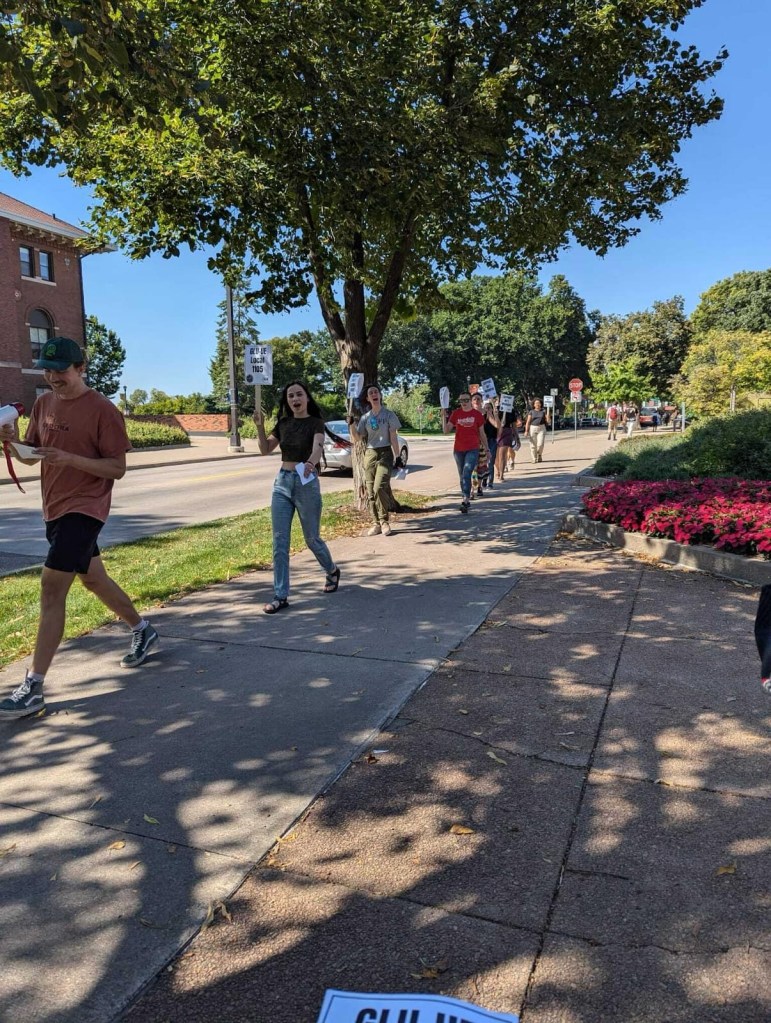
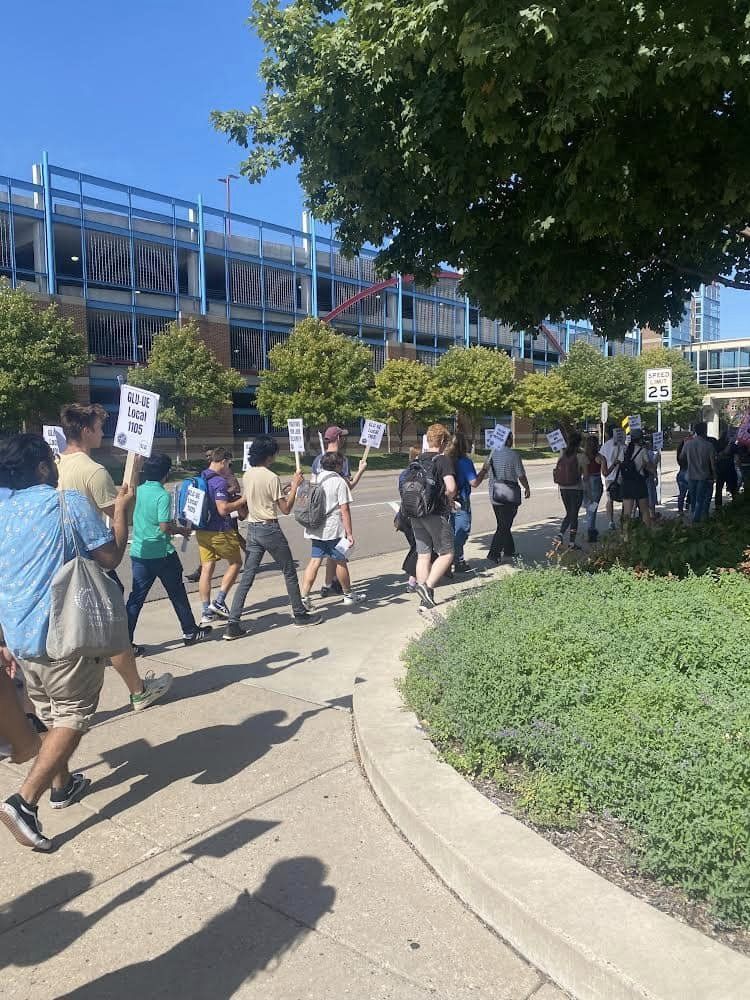
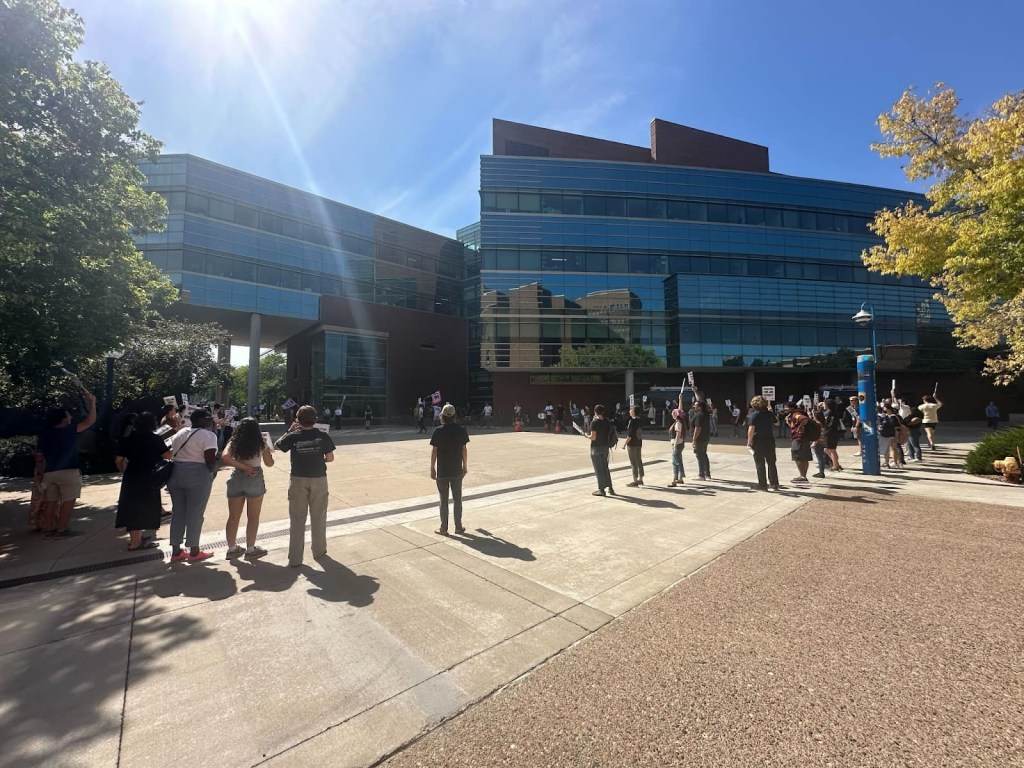
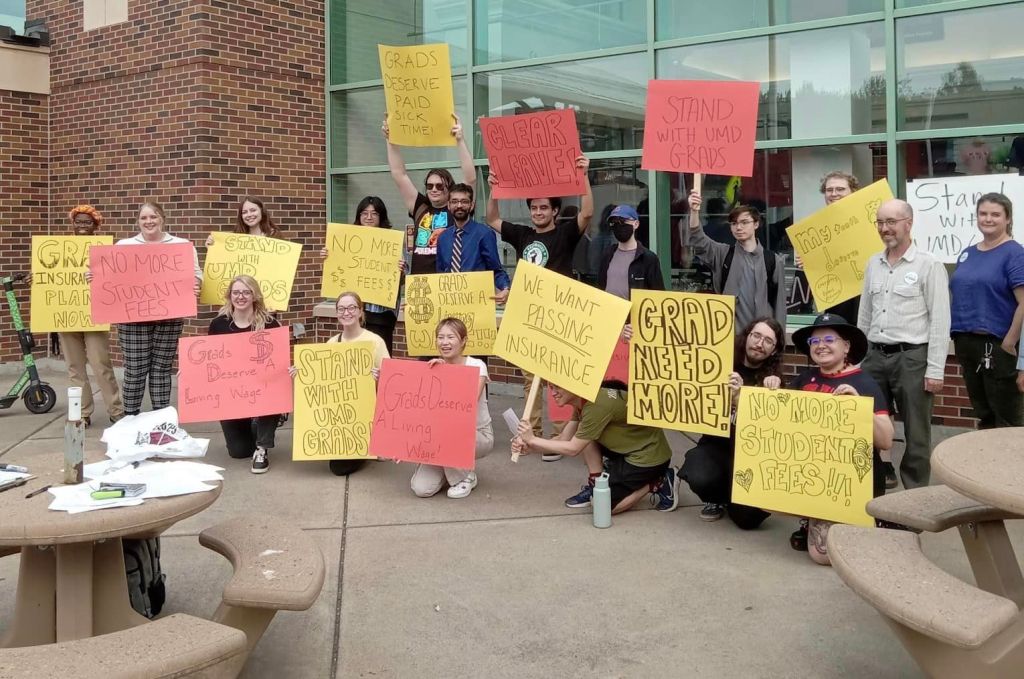
➤ September 13, 2024: Picket for Fair Pay, No More Fees, and Real Protections
GLU-UE 1105 members started the semester by showing the administration that grad workers around the University are invested in this fight and are willing to stand up for their rights. This picket occurred all day on all four campuses, with thousands of grad workers taking the time to stand with their coworkers for a living wage, no more fees, and real protections against harassment.

Summer 2024
➤ August 28-29, 2024
We’ve got some updates from bargaining last week to kick off the semester. Even with a state-appointed mediator joining our sessions, University administrators remain steadfast in denying us grad workers:
- A living wage that reflects the value that all of us graduate assistants provide the University
- Coverage of student fees as a benefit of employment
- Protections against a hostile workplace and abusive advisors/supervisors not covered by Title IX
- Recognition of Graduate Fellows as union workers deserving of union protections, in accordance with Minnesota State Law
It’s time to be so loud we can’t be ignored. Every single agreement made so far is the direct result of grad workers organizing and showing that we have strength in numbers. Here is what you need to do:
- Sign up to picket with your coworkers for at least one hour on Friday, September 13th. If we want higher pay and no more fees, everyone needs to show up for at least one hour between 8am and 6pm. Separate pickets will occur on St Paul, West Bank, East Bank, and Duluth. This is one of our last chances to show the University that we stand together in the fight for the contract that we deserve!
- Contribute to the fight and pay your fair share by signing up as a dues-paying member! Interim dues are optional deductions of 1.44% from your biweekly paycheck that go directly to GLU-UE. Paying dues strengthens our union by allowing us to pay for supplies for actions like the September Picket. Together, we will also be pooling resources into a hardship fund to financially support our members experiencing economic hardships such as a missed paycheck or unexpected medical bill.
- Save the Date for our next General Membership Meeting: Wednesday, Sept. 25, learn how to submit a proposal!
Let’s get out there to show the U we care about our contract and our working conditions!
➤ August 15-16, 2024
Last week’s bargaining session brought some wins, but also clearly illustrated the issues we will need to fight for this fall. Here are the takeaways:
Discrimination and Sexual Misconduct: After 9 months of the U ignoring this article, the administration finally granted grad workers access to the grievance procedure and a union steward for discrimination and sexual misconduct cases, allowing us to make a tentative agreement on this article. This is a direct reaction to hundreds of grad students picketing the Board of Regents in July about this very issue. When we fight, they move. It is time we replicate this for Pay and Fees.
Fees and Compensation: The U refuses to cover any fees. We shouldn’t have to pay to work for the U, and international workers shouldn’t have to pay even more. For pay, the U offered $25/hr or $26,000/year (12 mo appointment). While an increase from their original proposal, this is still more than $10,000 below the cost of living in Hennepin County.
Inclusion of Fellows: In July, Minnesota law changed so Graduate Fellows are public employees. There is no reason that fellows, who do the same work side-by-side with other GAs, should not get protections from this contract. The University is poised to deny Fellows access to these rights. Just today, they told us that they refuse to deduct dues from Fellows’ paychecks. If you are a Fellow, and you have not signed up for membership in our union, now is the time – this is the best way to tell the U that you are not accepting this.
➤ August 1-2, 2024
In last week’s bargaining session, the University tried, yet again, to deny our rights as workers under the assertion that when we are students, as opposed to workers, the terms of our Union contract should not apply. Can you clearly separate the tasks you do as a worker and those you do as a student? University administrators insist that there is a clear distinction between our two roles, but they are not in our workplaces, and they do not understand our work. However, we were still able to make some progress. Here are the highlights of last week’s session:
- The University initially did not respond on compensation, but after our committee pushed, they returned with an increase of 50 cents per hour compared to their prior proposal. This is positive movement, but we need to keep fighting for a living wage and no more fees! Grad workers needed a raise yesterday.
- After our picket last month, when we demanded protections from harassment and discrimination, the University finally gave a response on Article 8: Nondiscrimination, which does not bar us from using the Union grievance procedure in cases of discrimination and sexual harassment. They also proposed a new Respectful Workplace article. While it was a clear step toward winning safeguards from abusive supervisors, their new proposal also carves out all “academic matters,” including all interactions between a GA and any member of their thesis committee, from respectful workplace protections. We offered a substantive counter in hopes of winning the safeguards from abusive supervisors that all graduate workers deserve.
- In a huge win for international workers’ rights, we reached a tentative agreement on Article 22, which shores up the rights of international workers to things like flexibility to take care of immigration-related matters and access to ESL resources, tax resources, CPT, and OPT.
- The University held their position that when a GA is let go from their job on arbitrary grounds, this is a purely academic matter and union rights shouldn’t apply. When we presented real examples of GAs being let go due to circumstances beyond their control, the University’s committee completely refused to engage in discussion.
We need to work together if we are going to win a good contract this year. Sign up for interim dues so we can build a stronger union to win this fight!
➤ July 18-19, 2024
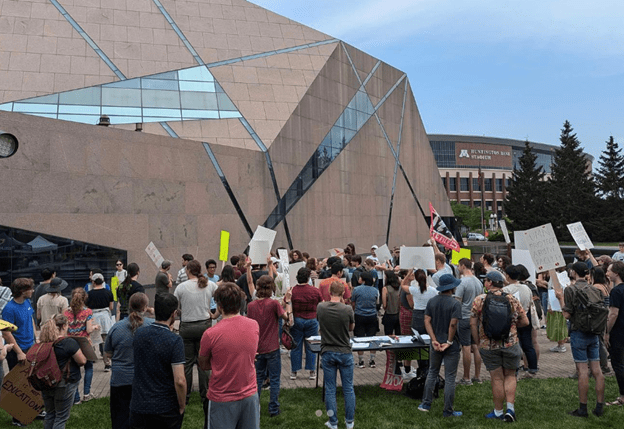
On July 10th, we held an informational picket at the UMN Board of Regents’ Annual Meeting where over 150 graduate workers showed up to demand a fair contract, and this Thursday’s bargaining showed just how meaningful our collective action and presence is to winning a good contract. In the last bargaining session, July 18th-19th, the U indicated that they are going to give a real response on our discrimination and harassment articles, which would be the first movement on this article since last October. We also secured two new tentative agreements on appointments and professional rights, and significant progress toward making sure international GAs do not have to pay tuition for required ESL courses.
While these are significant steps forward, our fight is far from over. As expected, we saw very little movement from the University regarding compensation—they “raised” their offer to a mere $24 an hour, just one dollar more than their previous counter. This is unacceptable, considering that 87% of GAs require supplemental income or support to afford basic living expenses, and the majority of us already make at least $24/hour. In response, we maintained our demand for a living wage for all graduate workers and prioritized pay rates up to the year 2027, aiming to secure a better future for current and future graduate workers.
The wins over the last bargaining session were in no small part due to the great turn out of fellow grad workers at the picket. It is clear that the path to winning a fair contract requires our continued collective action. If 150 of us coming together over the Summer gave us movement at the bargaining table, what can we achieve if thousands of us showed up this Fall? We must remain vigilant and committed, standing together with our fellow graduate workers to achieve the work environment and compensation we deserve.
➤ July 10, 2024: Informational Picket on Harassment and Abuse
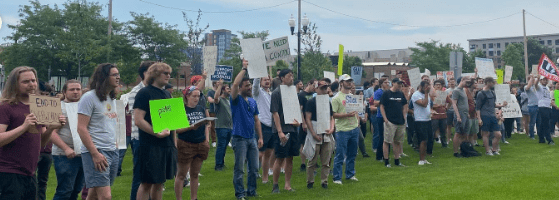
Over 150 grad workers picketed from 11:30am-1pm outside McNamara Alumni Center where the Board of Regents were meeting to discuss policy changes around harassment and discrimination. If the University’s real decision makers won’t come to the table to bargain with us, we will go to them!
The U has been stalling on these policies since contract negotiations began in September of last year. In contract negotiations the U has refused to agree to:
- Protections from all forms of harassment from faculty advisors, including non-sexual harassment, such as verbal insults, threats, and physical violence
- Access to our grievance procedure to resolve cases of sexual harassment, for workers who would prefer to resolve their case without going through the University’s prescribed procedure.
➤ June 20-21, 2024
On Thursday, in front of nearly 100 observers on Zoom, the University’s team showed up 20 minutes late to our regularly-scheduled bargaining session. They then presented their “counter” which included no forward movement at all. On Friday, only 3 out of 15 members of the University’s team showed up to hear our response, which included substantive counter-proposals informed by discussion at the bargaining table. Here are our major takeaways from this session:
- The University wants to protect faculty who create hostile work environments. Yet, they refuse to protect us. Since October, the employer has not responded to our proposals to protect grads from advisor abuse. There is no University policy that covers harassment when it’s not related to discrimination, and as such our advisors can belittle us, threaten us, and throw chairs with impunity.
- The administration wants to allow faculty to make arbitrary “academic” judgments that lead to us losing our jobs without just cause. In March, they acknowledged that academic standards tied to our employment are often ill-defined, and that the University has “work to do” on this front. Because doing the work would require shifting the University’s business model and holding supervisors accountable, they’d rather sit around (and collect their massive paychecks).
- There was no movement forward on any economic items.
The message from all of this is clear: the University simply does not respect its graduate assistants. High-level administrators seem to believe that we are disorganized and not willing to fight back.
➤ June 6-7, 2024
Last week, the U brought us their first comprehensive counter, meaning that for the first time since we introduced our economic platform in February, they have responded to every article we proposed, including on pay. $23 per hour and no job protections– that’s what they think we are worth. That is $23,920 per year for 12 months, and $17,940 for a 9 month appointment. Only 20% of GAs currently make below this minimum, meaning that they would be leaving 80% of us without a guaranteed pay raise.
So how much do the people who wrote this proposal make? Provost Rachel Croson makes $260/hour– (more than ten times what she thinks we should be paid), Grad School Dean Scott Lanyon – $129/hour, OHR VP Horstman – $142/hour, Outgoing interim President Ettinger – $192/hour, Incoming President Rebbecca Cunningham – $469/hour. While admin has increasingly bloated salaries, they are asking thousands of grad workers to produce research and teach their classes, while also offering us and our families poverty wages.
- They proposed no numbers for annual raises for those of us making above $23 an hour, instead asking us to accept that the Board of Regents gets to arbitrarily decide an annual raise, if any. All of this while the cost of living skyrockets each year.
- On top of that, they want us to continue paying untransparent semesterly fees. This includes the excessive fees they charge international GAs.
This is the university’s business model – to have us work for poverty wages and require us to pay them back for the privilege. So, the University has said what they are willing to pay us. What are you willing to do to fight for the wage that we deserve?
Spring 2023
➤ May 16-17, 2024
Last week, we had our first bargaining session with our newly seated Bargaining Committee members. Briana Beeman (Arts and Design), Ciarra Whindleton (Biomed), Clara Buck and Lucas Myers (SPAM), Danny Banegas (Duluth), Eva Nelson (CEHD), Jonathan Smith (BAM), Kiera Mac Neill (CLA-W), Amy Harbourne (CLA-E), and Malcolm Grossman (Computers) have joined our committee as we fight for our first contract.
This session, we received the first counter on medical benefits. With our proposal, we seek to lower the cost burden of dependent health care, expand dental and vision coverage, and eliminate the impact of erroneous loss of health insurance. Our big takeaway: the U is disorganized and they pass the cost of that disorganization onto us.
- The U has created a system where enrolling a dependent in health insurance requires 2-3 months of premium charges up front (over $800) before we even get our first paycheck. This places a massive burden on grads with dependents, and we should not be shouldering the costs of their disorganization.
- They rejected our proposals for dental and vision coverage. They claim they cannot give us the same benefits as other employee groups, merely because they house our insurance under the Student Health Benefits Office.
- The administration has made the system they use to manage employee and student benefits needlessly complex— a system they can’t even seem to figure out. Clearly, having such a bloated administration doesn’t benefit the U or grad workers.
- We tentatively agreed on our sections on gender affirming care and erroneous termination. This ensures costs are covered if your health insurance ends due to administrative error and maintains or improves access to gender affirming care.
We are excited to see some progress, but their counter only affirms the status quo — we are not interested in continuing this status quo. The hundreds of administrators who perpetuate a convoluted system cost the University $856 million, while the thousands of graduate workers are only allocated $180 million. This is not a scarcity problem — it is an allocation problem. Next session, we expect to see a response from the University on pay — stay tuned!
➤ May 2-3, 2024
The University’s bargaining team presented us with the least productive counter we have seen so far. We were left wondering why the University even bothered to meet. Their counter proposals showed backsliding on the non-economic language and no progress on economic articles.
- They outright rejected our proposal to cover our fees as a benefit of employment. Are we all going to accept this?
- We have repeatedly heard from our departments and supervisors that university administrators, especially Provost Croson, are spreading unfounded rumors about how much graduate workers are going to cost next year. Despite this, the administration has not bothered to give us a counter on pay. It is irresponsible for the university to be giving departments inaccurate information on pay when some departments are making hiring decisions based on this information.
- Despite acknowledging at the table that there are no current procedures to address cases of advisor abuse and harassment, the University has not even bothered to counter our language to address this issue. We requested copies of hostile work environment policies in 13 randomly selected departments across the U. Their response: only 3 departments have policies – and those policies were weak or unclear.
- We brought up the hasty and irresponsible building closures over the last week, explaining the acute safety risks posed to the graduate workers who work in labs and make key decisions. It is unacceptable to give us only 2 hours notice to vacate our workplace based on some vague and undefined threat.
We all need to take these fights into the fall. It is clear that the people sent to negotiate with us are not the real decision makers. We ask that if their advisory committee – Provost Croson, Dean Lanyon, and VP Horstman – are the people deciding what language they can and cannot include in our contract, then they should be in the room listening to us.
➤ May 1, 2024: Union Break
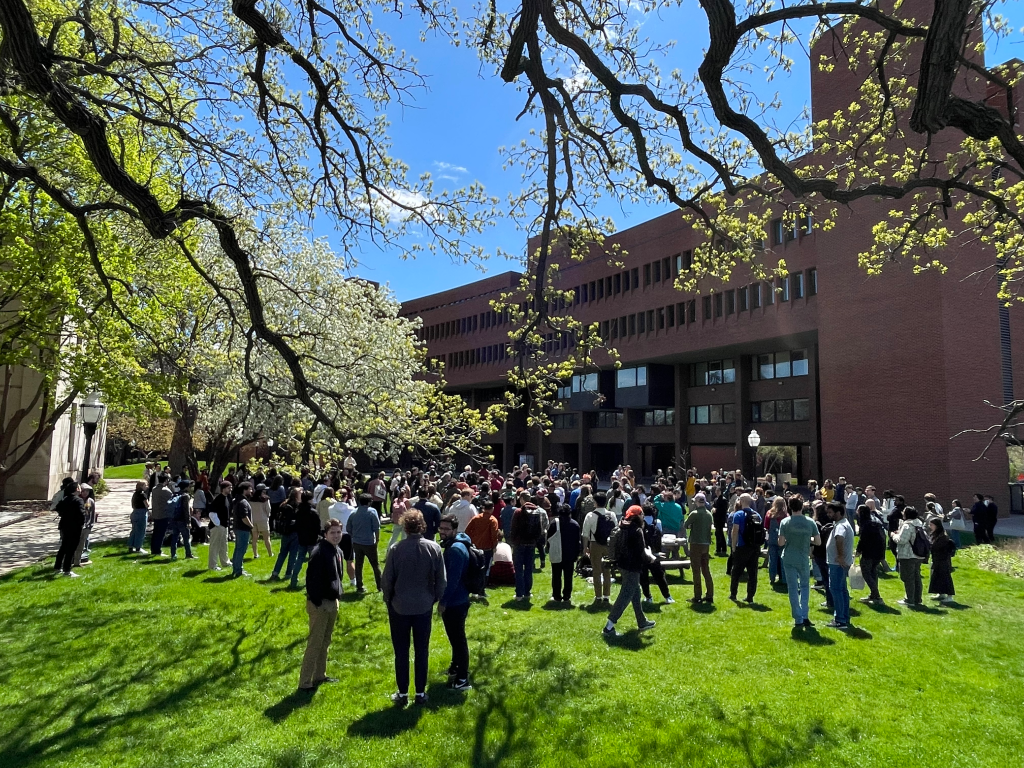
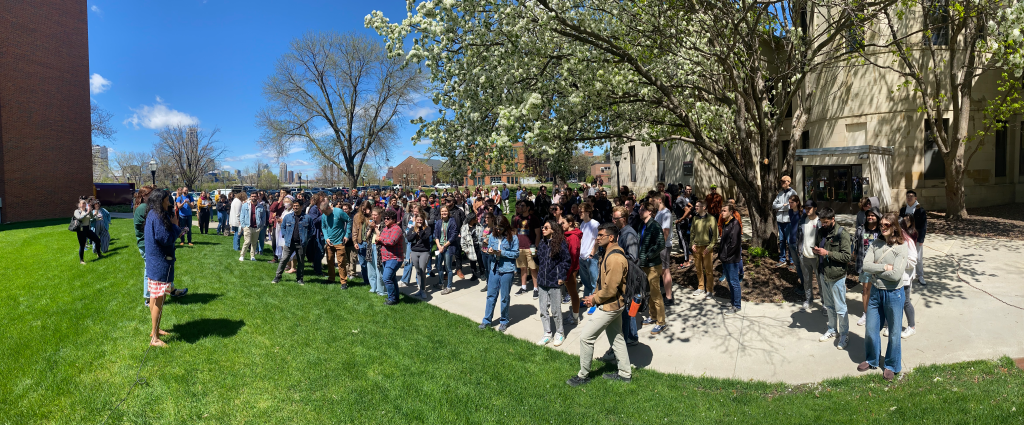
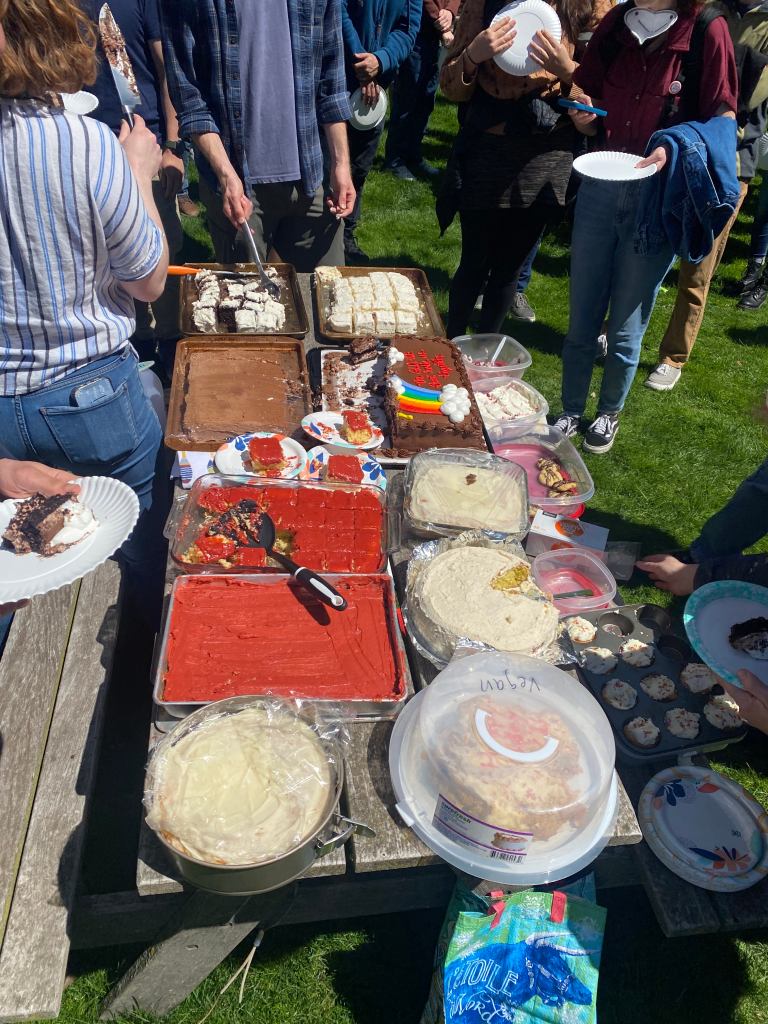
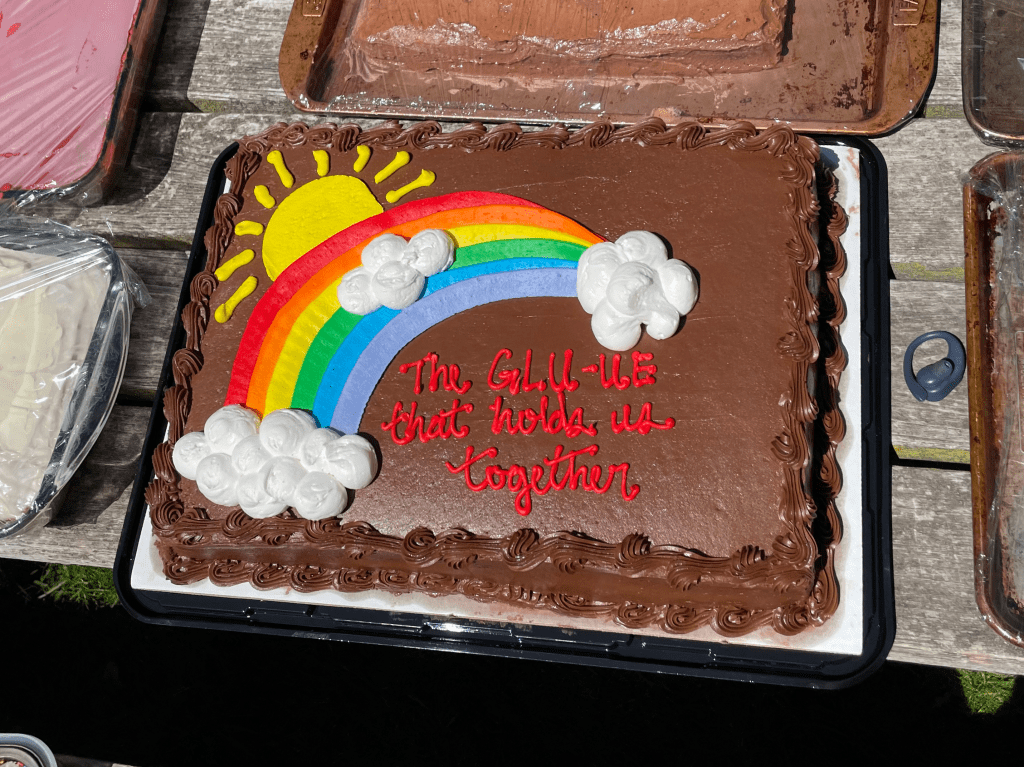
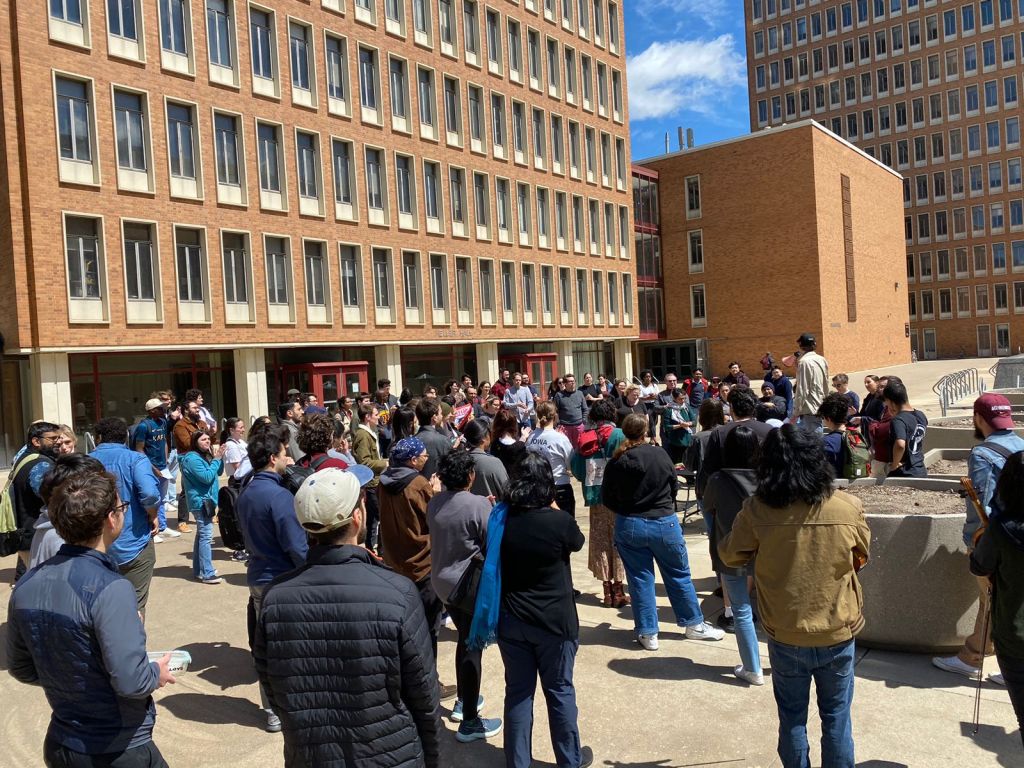
On May 1st, we had a successful Union Break. Hundreds of us came together across all campuses to collectively take a 30 minute break and celebrate one year since we voted in our union. The message was clear – we know what value we bring to the university and we know what we are worth. We keep the U functioning, so administrators better listen to our demands.
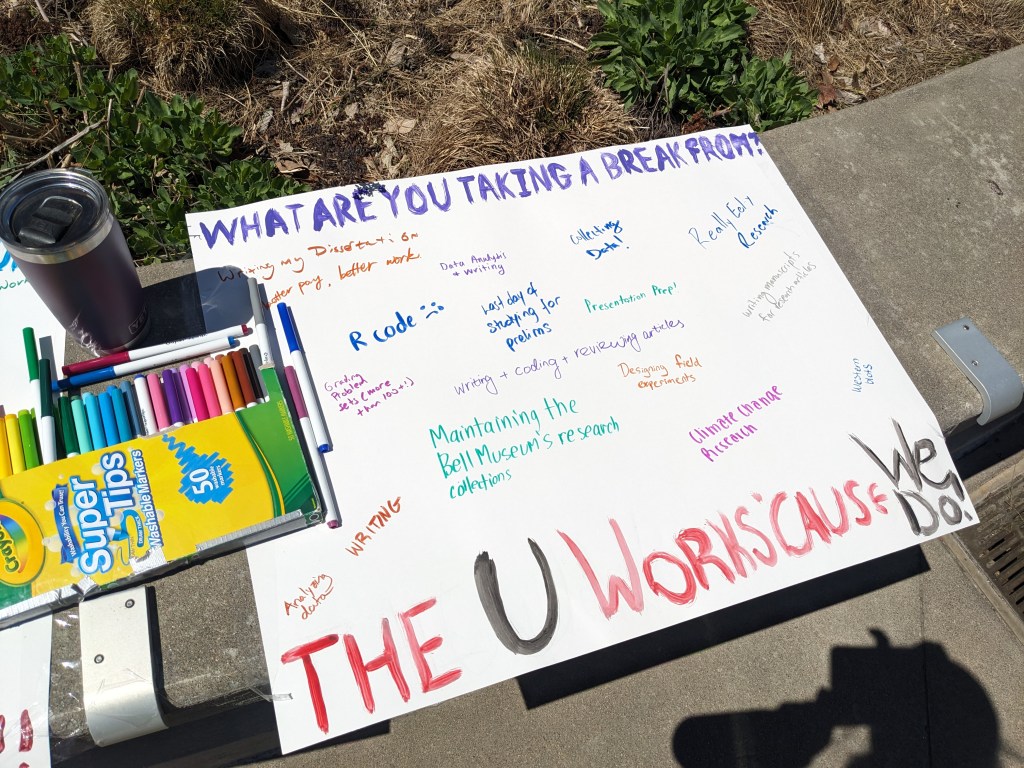
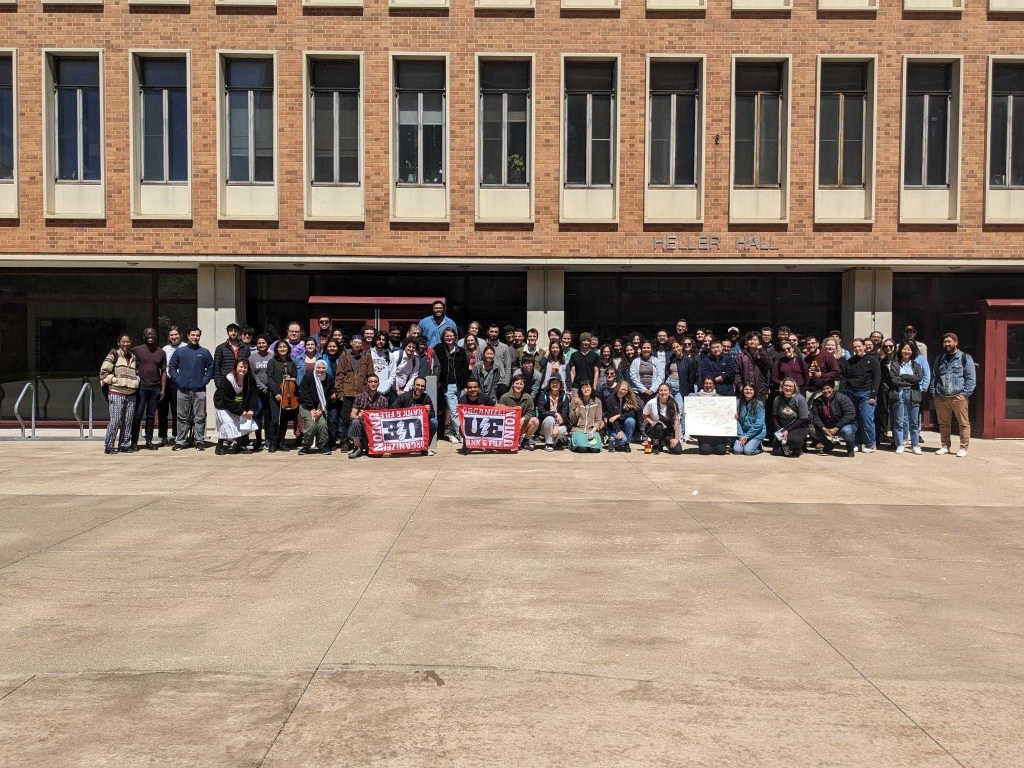
➤ April 18-19, 2024
We made significant progress on the remaining non-economic contract proposals on the table.
- International Workers’ Rights: The University finally agreed to reasonable timelines for processing visa paperwork and to allow grad workers time off for immigration proceedings, getting us closer to tentatively agreeing to our entire international workers’ rights article.
- Health and Safety: With guaranteeing access to the grievance procedure if safety violations go unaddressed, we have tentatively agreed on the entire article.
- Anti-Discrimination: The administration finally moved toward us on the issue of caste, bringing us closer to agreement on that article.
➤ April 4-5, 2024
After GLU members sent hundreds of emails to collegiate deans urging a response, the administration had no choice but to return with something – a counter on a few economic articles and numerous questions on the rest. This came after March 21st, when the U’s bargaining team stated in front of 150 grad workers watching on Zoom that they had no timeline for responding or reviewing to the Pay, Fees, and Benefits proposals endorsed by over 2,700 grad assistants.
Specifically, the employer brought counters on leaves of absence, commute subsidies, and employee assistance. They only had questions – no counter offer – for pay, fees, and health benefits. After discussing their questions (many of which were explicitly answered in our proposals), we reminded them that bargaining sessions will be better spent if they actually develop counters. Grad workers want a contract, not halfhearted questions from administrators.
We hope the Employer continues to take the right lessons from the emails sent to the Deans by returning on April 18th with a comprehensive counter on the remaining economic articles. Then, we’ll be able to dig into urgent negotiations over pay, fees, and health benefits.
➤ March 21-22, 2024
Despite 2,700+ graduate workers signing onto our Pay, Fees, and Benefits petition last month, the U’s bargaining team did not respond to a single economic article. They claimed that they “need time to cost these proposals”, but would not provide a clear timeline on when they would respond, even though they’ve had these proposals for 3 weeks. The U’s team effectively told the 150 grad workers observing on zoom and in person that our economic well-being is not a priority.
We all need to act together to pressure management to give us a response! Look for an email from your bargaining committee representative or contact a member of the Contract Action Team for information about emailing your college’s dean to pressure the U’s bargaining team and advisory committee (Grad School Dean Lanyon, Provost Croson, and HR VP Horstman) to stop the delays.
Make sure to sign off on your email and feel free to include a personal reason why you want to see the administration move on our union’s economic proposals!
On top of the lack of response on economics, they tried walking back an article they had previously agreed on (Article 17, Appointment Notification and Reappointment) which would secure us a clear, transparent, and grievable reappointment process.
The administrators responsible for our low wages make six figure salaries, and now they shrug off our proposal for a living wage, proving how disconnected they are with our lives. If this makes you mad, email your dean.
➤ March 1, 2024: Pay, Fees, and Benefits Petition
On March 1st, our bargaining committee (BC) presented our economic platform, alongside a petition signed by GLU-UE Local 1105 members. Over 2,700 graduate workers signed the petition, standing together in support of a living wage, no fees, comprehensive benefits, and clear and transparent leave policies!
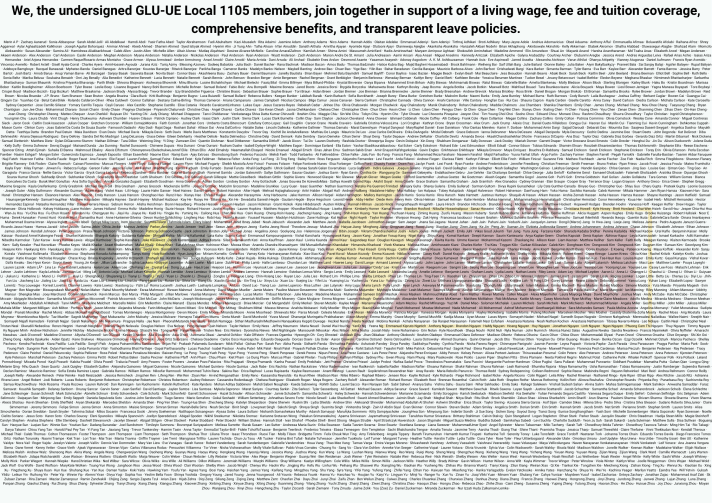
➤ February 29-March 1, 2024
On February 29, we presented our proposals on economic issues to the university. Over the last three weeks, over 2,700 graduate workers – 63% of us – signed onto our union’s platform for a livable wage, ending the fees, comprehensive benefits, and clear leave policies. Our message was clear in the bargaining room – grads need these proposals, and we needed them yesterday. Over the course of the last three weeks, thousands of us had conversations about these issues. We know that our power to move the employer comes from having conversations like these. The university would be wise to listen to us.
Even as we begin to negotiate over pay, fees, and benefits, the employer has demonstrated a reluctance to hold faculty and university bureaucracies accountable. The University still disagrees with language that would allow us recourse against unsafe workplaces, hostile or discriminatory supervisors, and opaque termination procedures.
We expect the employer to respond to the contract proposals – both the remaining Workplace Safety and Quality of Life articles and the proposed economic package – on Thursday, March 21.
➤ February 15-16, 2024
In this set of bargaining sessions with the University, we won tentative agreements on Workload and Appointment Duties and Scope of Work, meaning that we have successfully negotiated all of our Job Security, Transparency, and Workload articles!
With tentative agreements on most of our Workplace Safety and Quality of Life proposals, we will start negotiating over Pay, Fees, and Benefits soon. Before bargaining over these issues, thousands of grad workers around the University are signing onto the Pay, Fees, and Benefits bargaining platform. Signing on to this platform is your chance to demand that the University pays us enough to live, stops charging ridiculous and discriminatory fees, provides comprehensive health coverage, and allows us time off from work. Please reach out to me or a CAT member to sign today!
A few sticking points remain, even as we approach bargaining over economic issues. We need to continue to fight for protections over discrimination, hostile work environments, academic discipline and discharge, and international workers rights. The University might attempt to make us choose between these vital workplace protections and higher pay and better benefits. However, we need to reject this dichotomy: with administrators taking home six figure salaries and spending millions on consulting fees, the U has the money.
Real security means protections against workplace abuse and better economic support. We can only win real security in our contract if we stay organized.
➤ February 1-2, 2024
We had another set of bargaining sessions with the University on Feb. 1st and 2nd, making more progress on our Workplace Safety and Quality of Life proposals. But the continued fight for workplace protections and meaningful economic support doesn’t just happen at the bargaining table. Over the last two weeks, Grad workers came together in a series of 18 townhalls to discuss our union’s Pay, Fees, and Benefits bargaining platform.
Join the fight at this Wednesday’s General Membership Meeting!
- We have made tentative agreements on our grievance and arbitration articles, giving us a robust process for enforcing our contract!
- The employer once again failed to provide a counterproposal on international workers’ rights. Despite international workers making up a huge portion of our union– comprising the majority of many grad departments – this is the only article to which the University has consistently failed to give a response.
- The employer keeps asserting that their current policies on hostile work environments and discrimination are sufficient. The university is reluctant to hold faculty accountable for abusive behavior, despite its own internal reviews calling for meaningful recourse.
- The employer refuses to respond to academic discipline and discharge language. They created a system that entangles our roles as students and workers, yet they continue to claim a right to fire us for “academic” reasons even if those reasons are unclear.
Through continued organizing across the University, GLU-UE members have been able to push our employer to tentatively agree on a majority of the articles brought to the table in September. However, the University is still trying to avoid accountability for egregious faculty abuse and insufficient support for international workers. To win what we deserve, we need to keep organizing. Attend Wednesday’s General Membership Meeting to go over the Pay, Fees, and Benefits Platform and to learn how to build power in your lab or office.
➤ January 18-19, 2024
On January 18th and 19th, we resumed bargaining for the spring semester. After hundreds of graduate workers rallied outside bargaining on December 1st, administrators were pushed to meaningfully respond. On Thursday, the University finally gave us a counter on every article. This includes their first response to the international workers’ rights proposals.
This substantive counter allowed us to make six new tentative agreements, including on union rights, professional development, and job security. The employer withdrew their proposal to retain the right to discharge workers if the university can’t meet disability accommodations. While there is still progress needed – including on academic discipline and discharge, hostile work environments, and nondiscrimination – the last bargaining session was a positive step towards a contract that gives us all better workplace protections and rights.
With this forward movement, we are preparing to negotiate on pay, fees, and benefits, and we need your input. Over the next week and a half, there will be a series of townhalls to discuss the pay, fees, and benefits bargaining platform, which will be finalized at a GMM on February 7th. Here is the full townhall schedule and the proposed platform. If you can’t attend your area’s town hall, feel free to email me or attend a different townhall. As a union, we need to understand our collective needs and priorities: this includes you.
Fall 2023
➤ November 30, December 1, 2023
On Friday, December 1st, we wrapped up our first semester of negotiation with the employer. Despite having three weeks to respond, the employer did not present a substantive counter. While we have made progress on some articles, we want to flag the employer’s inaction on the following crucial contract issues.
- International Workers Rights – The employer has refused to respond to our proposals, claiming they do not have any experts on the subject on their team, and that they consider these rights to be purely economic.
- Hostility and Harassment – The employer wants us to only be able to grieve abusive work situations after we’ve gone through internal university processes. We know that we would not be negotiating over other pathways for addressing these things if the current process protects grad workers. Their preferred policies also do not cover hostile situations unrelated to discrimination or sexual harassment, leaving a huge gap in protection.
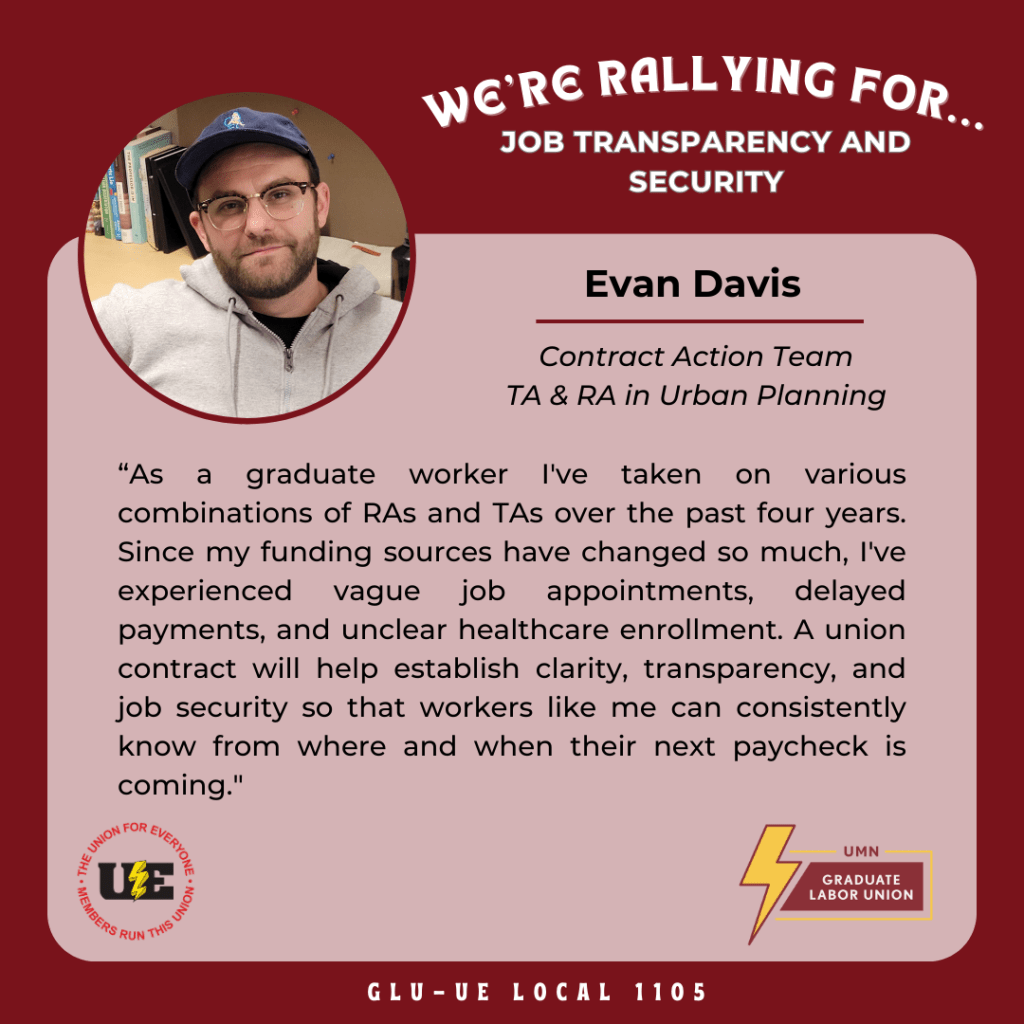
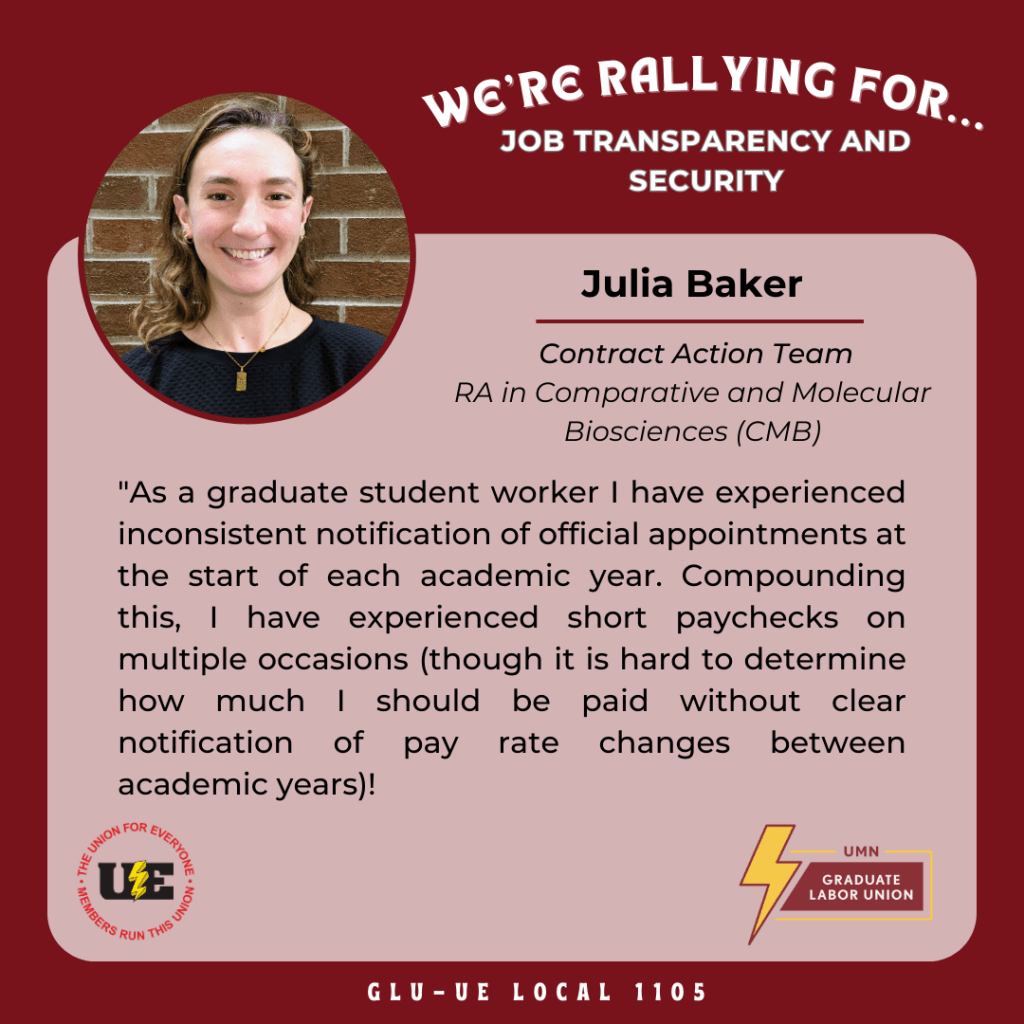
- Workload and Professional Rights – The employer is trying to restrict our contract to nonacademic issues, while adopting an extremely expansive definition of academic work. Under their definition (“academic work is anything that touches academics”), our contract would not cover TA or RA work necessary to graduate. This would severely limit our ability to grieve burdensome or inappropriate workloads. This would also limit the contract’s ability to secure professional and academic freedom, IP rights, and access to remote work and timely reimbursements.
- Discipline and Discharge – Since October, the employer has held that they should be able to fire graduate workers for two particularly egregious reasons. First, they maintain any termination related to “academics” should not be subject to our contract or its grievance procedure. Second, that if the university is “unable” to meet disability accommodations, they can fire you. In both cases, the employer is deliberately trying to retain the right to fire us arbitrarily, with impunity.
- Health and Safety – The employer wants to limit our ability to file grievances over workplace safety hazards, claiming that we should only be able to grieve if the employer first evaluates a situation as unsafe. This gives them latitude to determine what is safe and what isn’t. However, when lead is present in a lab or a fire alarm is not loud enough to hear, we are the ones who suffer the consequences, not them.
- Nondiscrimination – The employer has repeatedly crossed out characteristics that are not currently included in their nondiscrimination policies, leaving us at the status quo. If the university has its way, any supervisor could discriminate based on caste, ancestry, pregnancy status, HIV antibody status, political affiliation or belief, immigration status, citizenship status, medical condition, arrest or criminal record. In bargaining, we asked the university if they intend to discriminate against grad workers on these characteristics. They had no response.
While the employer had their own internal meeting on Friday, hundreds of graduate workers rallied outside the Carlson School (where bargaining took place) to speak out on the very issues listed above. With this show of collective action, the pressure is on the employer to respond more substantively when we resume bargaining in January.
If you care about these issues and want to see change at our workplace, join the Contract Action Team (CAT). We can only win a strong contract if we stand together and keep organizing.
➤ December 1, 2024: Rally for Workplace Protections
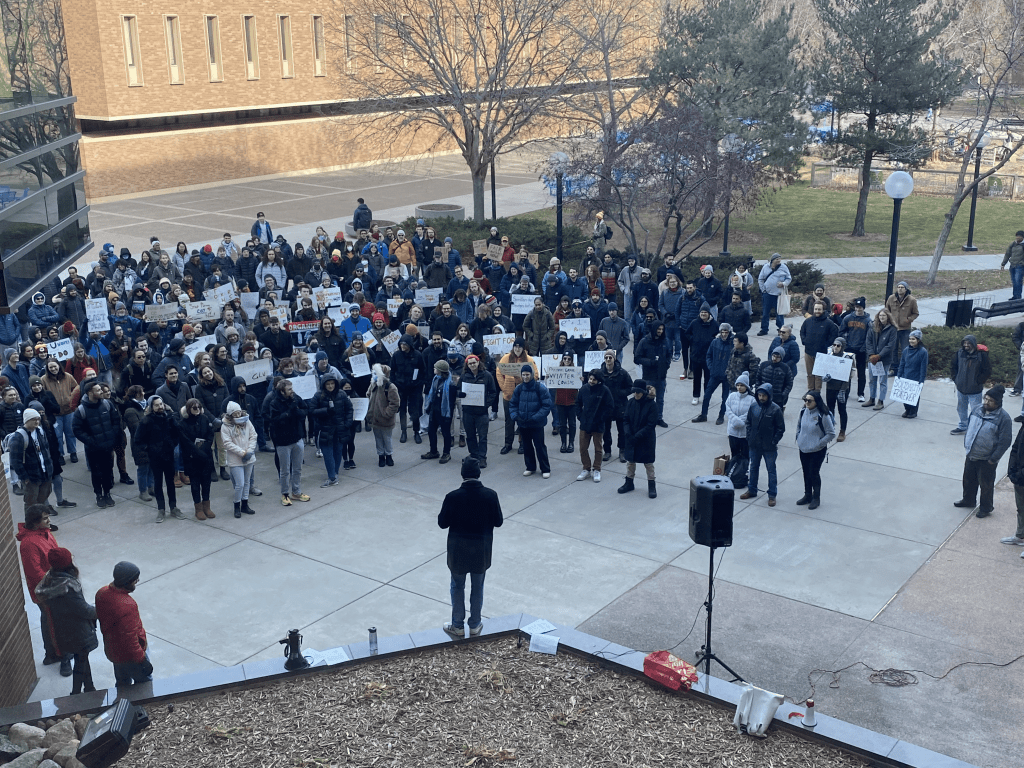
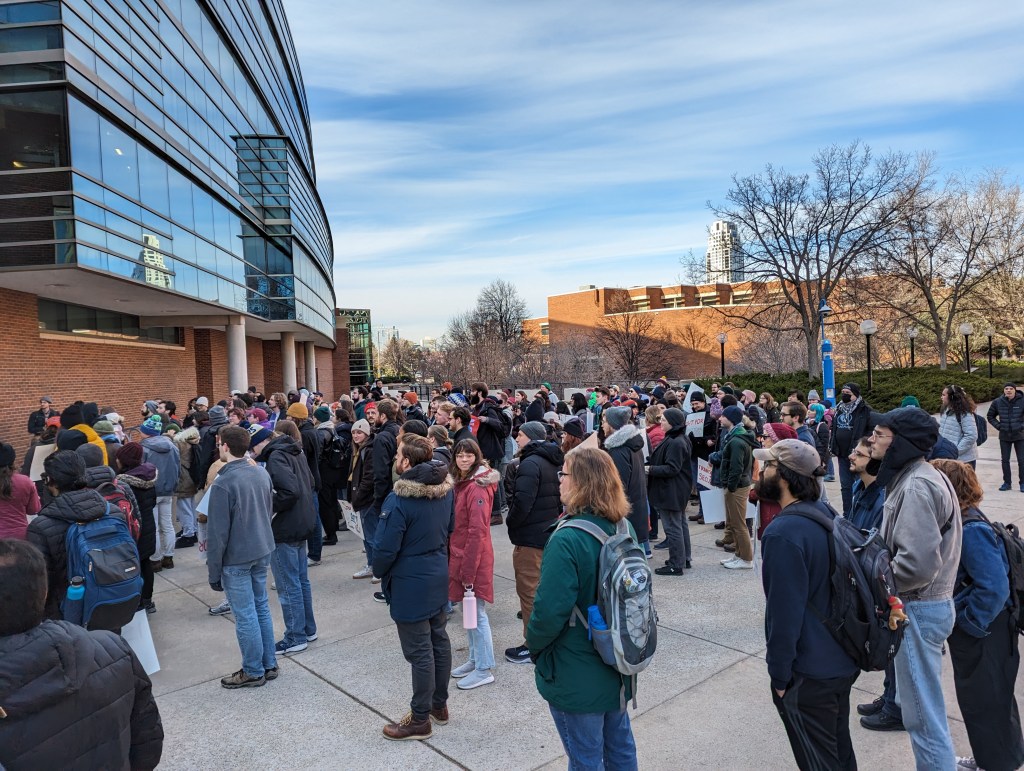
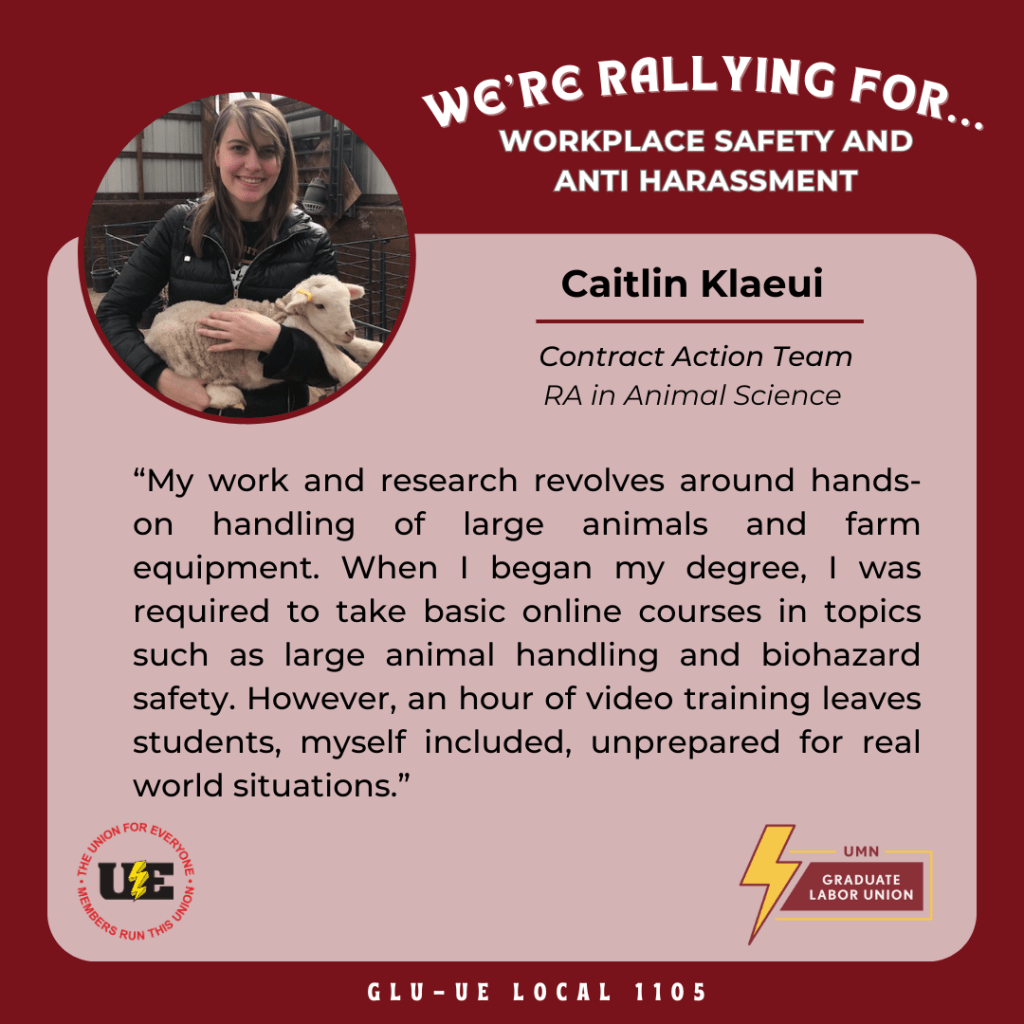
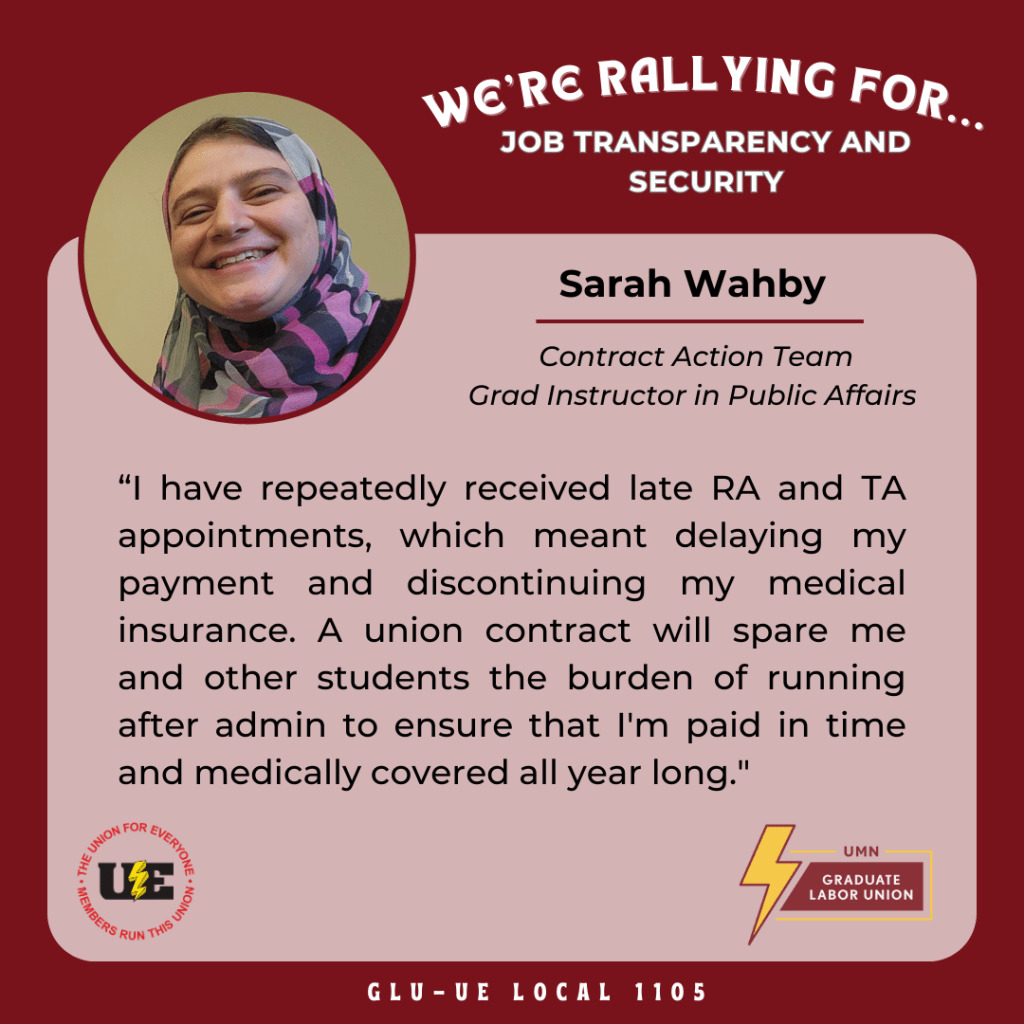
While the employer had an internal bargaining meeting on Friday, hundreds of graduate workers rallied outside the Carlson School (where bargaining took place) to speak out on the importance of international employee rights, nondiscrimination, health and safety, and discipline and discharge procedures. Workers from across departments, campuses, and schools spoke on each of these issues and why grad workers at the U need these protections. With this show of collective action, the pressure was on the employer to respond more substantively when we resume bargaining in January.
➤ November 9-10, 2023
On November 9th and 10th, we continued negotiations with university administrators. Out of the 26 articles currently on the bargaining table, we tentatively agreed on 2 additional articles, including an overhaul of the university’s job posting process! Also, we received new responses from the employer on 12 articles and have yet to hear back on 3 articles. To view the articles, check out our bargaining tracker. Some highlights:
- While we appreciate the employer’s substantive response to the grievance procedure proposal, we are wary that they want to carve out exceptions. In cases of overworking, discrimination, harassment, and workplace safety violations, they want us to use their internal university processes before filing a union grievance. We know these current procedures are ineffective, which is exactly why we need a robust union grievance procedure.
- The employer did not meaningfully move on some issues highlighted previously. They are still holding on a clause that allows them to fire us if they cannot meet accommodation needs under the ADA.
- The employer postponed all discussion of international workers’ rights, rejected proposed protections for undocumented workers, and claimed these issues are merely “economic matters”. The employer continually fails international workers, all while recruiting abroad and touting a commitment to DEI. By framing these rights as a cost, the employer actively dismisses international workers.
- The employer asserted that they don’t see work that contributes to academics as related to employment. In discussion, we called out the consequences of the employer’s separation of our “academic” work from our graduate assistant work, with examples regarding intellectual property, grant writing, and fulfilling teaching requirements for degrees. The employer is attempting to reduce the power of our contract, despite the fact that our labor provides value to the employer.
The employer claims that they do not fully understand our workplace, yet they feel qualified in telling us which protections we deserve. By repeatedly citing how decentralized the university is, administrators ignore the common factor that binds our union together: graduate workers keep the university running.
➤ October 26-27, 2023
On October 26th and 27th, we made progress on several contract articles. We have received counters from the employer on a majority of the Quality of Life and Workplace Safety proposals. Here are the main takeaways:
- While we are making progress on workplace health and safety, the employer attempted to reserve the right to evaluate the credibility of reported hazardous conditions. But this is the very problem: often, grad workers report unsafe conditions that the employer then hastily determines are safe without full explanation or investigation.
- The employer attempted to reserve the right to discipline or discharge a graduate worker from their jobs for academic performance without recourse, reflecting their stated belief that our roles as workers and students are completely separate. We know that this is not true. We asked for clarifications on their perspective for the next bargaining session.
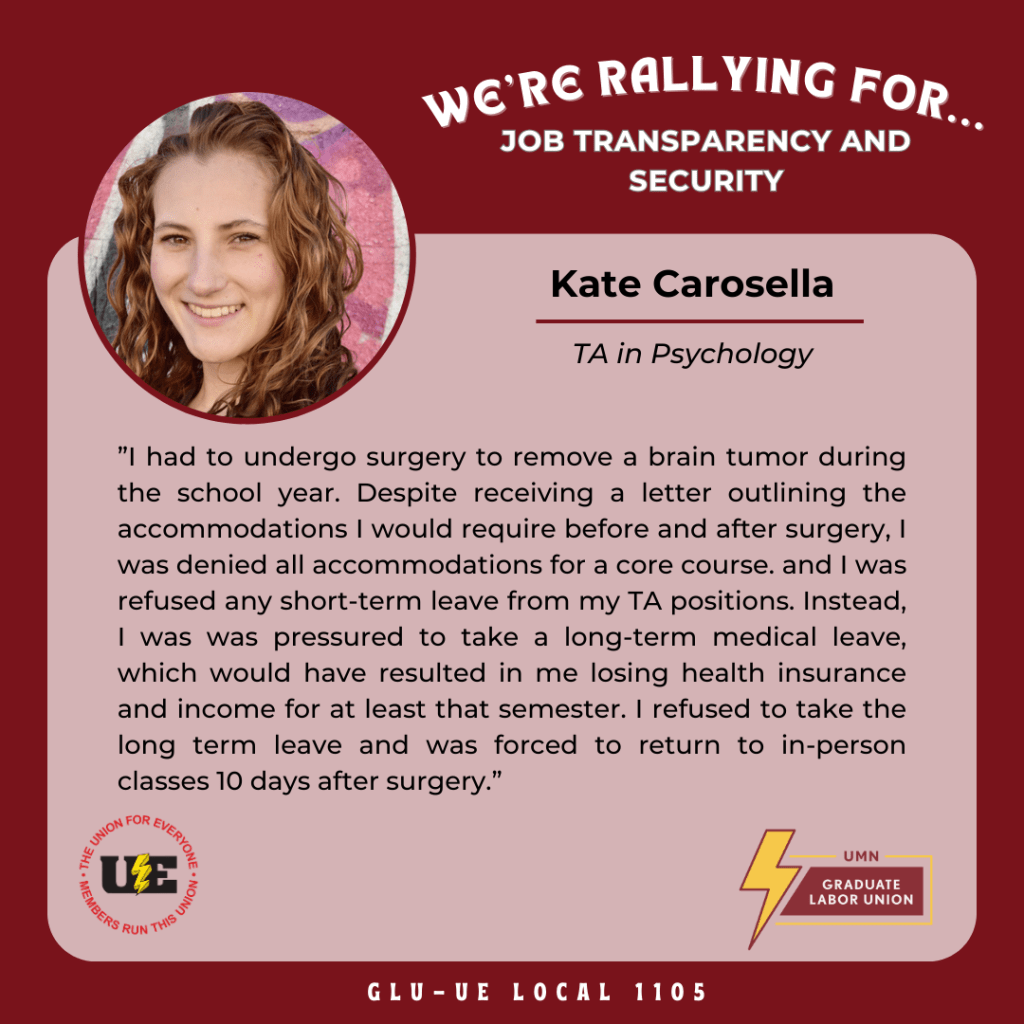
- The employer tried to assert that they should be able to terminate graduate workers if they are not able to meet accommodation needs under the ADA. We have sought further clarification and would like to hear from you if you have experience getting accommodations through the DRC.
- The employer has not yet presented a counter to our international employee rights article, instead asking us basic questions about the visa process and claiming that their delay was because they are not experts on processes governing international labor. The actual experts on these processes – international workers themselves – directly answered their questions. We await the employer’s counter.
As we look forward to our next bargaining sessions on November 9th and 10th, we hope that the administration recognizes that all grad workers – including disabled workers, workers facing discrimination and unsafe work conditions, and international workers – make the University function.
We will be discussing further details at our next General Membership Meeting at 5:30pm Monday, 10/30 (RSVP here!).
➤ October 12-13, 2023
On October 12th, we heard responses and questions from the employer on our proposals. October 13th, we spent our bargaining session responding to each of the employer’s counter-proposals and giving testimony. Here are the main takeaways:
- The employer responded to only 6 out of the 21 articles that we presented a month ago. We responded to each counter-proposals within a day.
- The employer has not yet responded to proposals that grad workers around the university have highlighted as vital, including workplace safety, grievance procedures, nondiscrimination, scope of appointments, and international worker rights.
- Thanks to testimony provided by graduate workers across academic disciplines, the Bargaining Committee directly responded to questions asked by administrators about how graduate workers are pushed to work in unsafe situations and to perform duties well outside the scope of our appointments and job descriptions.
While bargaining was in session, grad workers around the university wore buttons in support of these proposals. With this show of solidarity, we expect meaningful responses from the employer when we return to the bargaining table in two weeks.
➤ September 11, 2023: Bargaining Begins
TLDR:
- The bargaining committee presented our proposals to the employer, university administration.
- Opening statements were presented by bargaining committee representatives highlighting why we, graduate workers, are demanding better conditions and the history of GLU.
- We expect to hear the employer’s response to our proposals at the next bargaining session on October 12th.
During our first bargaining session with the University, Sam Boland, a Bargaining Committee (BC) representative from Biomedical Engineering put it well: “I chose the University of Minnesota because of a reputation of competitive stipends, world class facilities, and excellent mentorship. Over my 4 years, I have watched the U of M fail to exemplify these values, and ultimately fail its workers.” What Sam said is true and encapsulates the experiences of so many workers here at the University.
To address these issues, we presented the workplace safety and quality of life proposals summarized in our ratified bargaining platform to the University. You can see the proposal language in the bargaining tracker (above). The University’s team (below) has agreed to meet with us next on October 12, which is when we expect to see their counter proposals. In other words, the ball is now in the employer’s court.
As we move through the bargaining process, you can expect updates from your bargaining committee through:
- Our newly launched bargaining tracker
- Email updates like these
- Individual conversations with BC and CAT representatives
- General membership and area meetings
Employer attendance:
- Kari Seime (Labor Relations Consultant)
- Coy Hillstead (Assistant Director of Human Resources)
- Amy Hietapelto (Interim Executive Vice Chancellor for Academic Affairs in Duluth)
- Greg Thruston (Director of Student Health Benefits)
- Erik Brown (Associate Vice Chancellor for Graduate Education and Research in Duluth)
- Michael Huyen (HR Director for College of Biological science)
- Bryson Barth (HR employment specialist)
- Etty DeVaux (Chief Operating Officer, Executive Director, Grad Ed Policy Office)
- Victor Barocas (Interim Dean for CSE, Professor of Biomedical Engineering)
- Ann Meier (Associate Dean for Research & Graduate Programs in CLA, Professor of Sociology)
- Tabitha Grier-Reed (Associate Dean for Graduate Education and Faculty Development in CEHD)
UMN Administration Bargaining Committee Roster
- Kari Seime (Labor Relations Consultant)
- Coy Hillstead (Assistant Director of Human Resources)
- Amy Hietapelto (Interim Executive Vice Chancellor for Academic Affairs in Duluth)
- Greg Thruston (Director of Student Health Benefits)
- Erik Brown (Associate Vice Chancellor for Graduate Education and Research in Duluth)
- Michael Huyen (HR Director for College of Biological science)
- Bryson Barth (HR employment specialist)
- Etty DeVaux (Chief Operating Officer, Executive Director, Grad Ed Policy Office)
- Victor Barocas (Interim Dean for CSE, Professor of Biomedical Engineering)
- Ann Meier (Associate Dean for Research & Graduate Programs in CLA, Professor of Sociology)
- Tabitha Grier-Reed (Associate Dean for Graduate Education and Faculty Development in CEHD)
- Michael Lipscomb (Associate Dean for Graduate Education, Medical School)
 UMN Graduate Labor Union